
Video companion
Peter Shor in his own words: implications for your PKI
Peter Shor describes how quantum computers use interference to find periods — the breakthrough that threatens RSA. Hearing it from the inventor reframes urgency for PKI owners.
What the video gets right
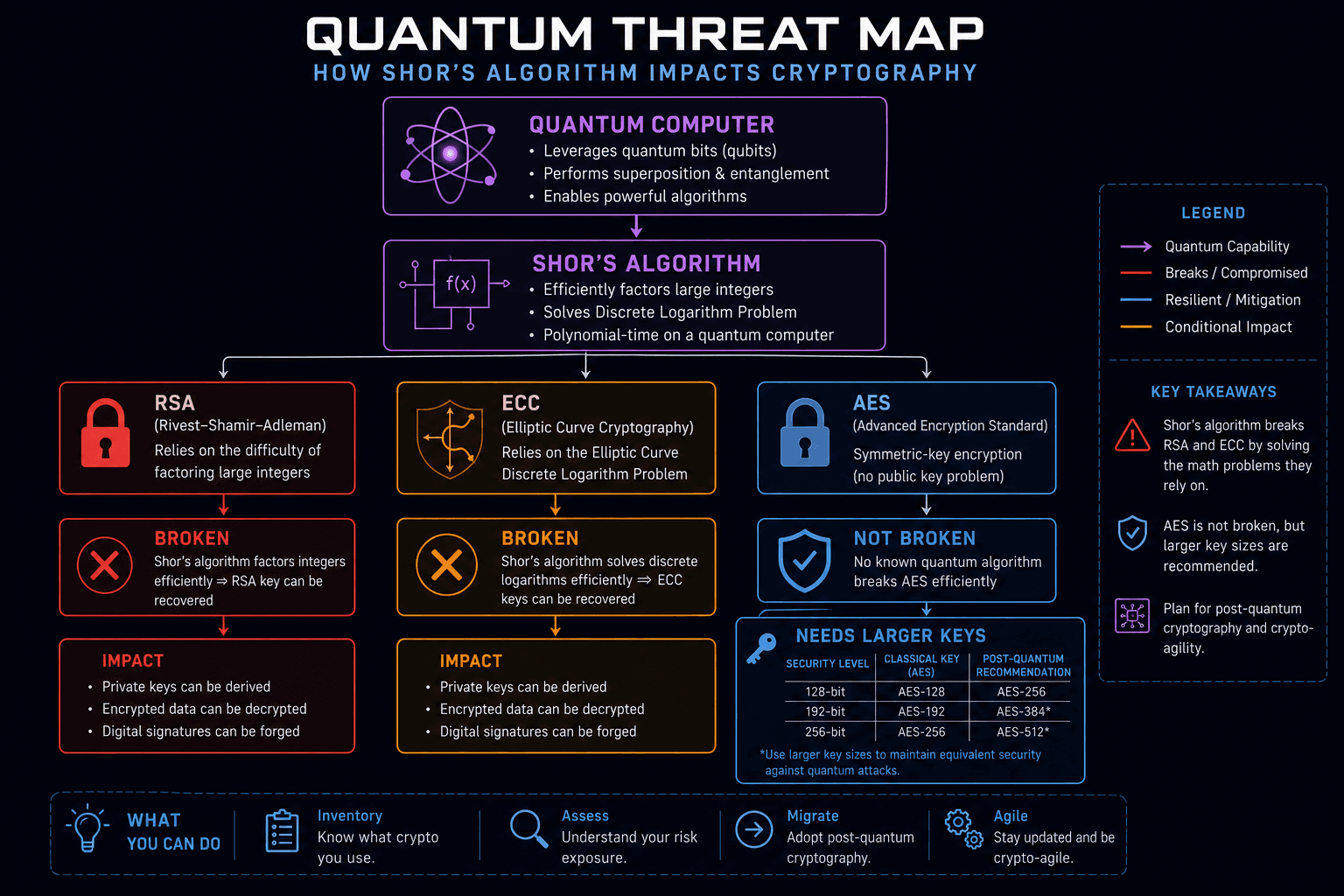
Shor explains the quantum factoring algorithm as turning a factoring problem into period-finding, then using a quantum computer as a "computational interferometer" to read off the period. Classical factoring takes exponential time; Shor's runs in polynomial time on an ideal quantum machine.
That asymmetry is why ML-KEM (FIPS 203) replaces ECDH for key exchange and why NIST IR 8547 sets deprecation timelines for RSA and elliptic-curve algorithms.
What it does not cover
Shor's algorithm requires millions of logical qubits with error correction to break RSA-2048 in practice — but HNDL does not wait for that milestone. Ciphertext captured today remains at risk for the confidentiality lifetime of the data.
See the NIST PQC overview for the harvest-now-decrypt-later threat model.
This quarter
- Brief your PKI team using this video plus the ML-KEM framework guide.
- Identify code-signing and document-signing certificates on RSA or ECDSA.
- Schedule hybrid TLS pilots using ML-KEM alongside classical algorithms during transition.
Continue on the Q-Day hub: What is Q-Day? guide
References & further reading
Authoritative primary sources cited in this article. Summaries are our own — follow links for full context.
Last verified 2026-06-21
- What is Shor's factoring algorithm? (Peter Shor)Physics World (YouTube) · 2015Peter Shor introduces his factoring algorithm and quantum computational advantage.
- What Is Post-Quantum Cryptography?NIST · 2024Official overview of NIST's PQC project, finalized standards, and the harvest-now-decrypt-later threat model.
- FIPS 203 — Module-Lattice-Based Key-Encapsulation Mechanism (ML-KEM)NIST · 2024-08Standardized post-quantum key encapsulation (formerly Kyber).
- NIST IR 8547: Transition to Post-Quantum Cryptography StandardsNIST · 2024Federal transition guidance with deprecation timelines for quantum-vulnerable algorithms.
See your exposure with evidence
Run a live PQC inventory scan, export a CBOM, and verify signed reports independently.